Activity 1.5 helps students understand the effect of heat on ferrous sulphate crystals. When ferrous sulphate crystals are heated, the colour of crystals changes. This activity demonstrates both thermal decomposition and the concept of water of crystallization which are important topics.
Activity 1.5 Class10 Science
Objective
To observe the effect of heat on ferrous sulphate crystals and identify the changes in the colour due to the chemical reaction.
Material Required
- Boiling tube
- Ferrous sulphate crystals
- Tongues
- Spirit lamp or burner
Procedure
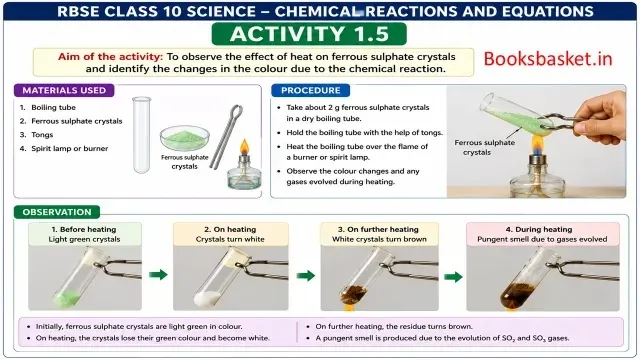
- Take about 2g of ferrous sulphate crystals in a dry boiling tube.
- Hold the boiling tube with the help of tongs.
- Heat the boiling over the flame of a spirit lamp or burner.
- Observe the colour changes and any gases evolved during heating.
Observation
- Initially ferrous sulphate crystals are light green in colour.
- On heating the crystals lose their green colour and become white.
- On further heating, the residue turns brown.
- A pungent smell is produced due to the evolution of Sulphur dioxide and Sulphur trioxide gases.
Chemical Reactions
FeSO4.7H2O(s) → FeSO4(s) + 7H2O(g)
2FeSO4(s) → Fe2O3(s) + SO2(g) +SO3(g)
Explanation
Ferrous sulphate crystals are hydrated salts containing water of crystallization which is responsible for green colour of crystals.
When ferrous sulphate crystals are heated, they lose water of crystallization and become anhydrous ferrous sulphate which is white in colour
On further heating of anhydrous ferrous sulphate produces ferric oxide, Sulphur dioxide and Sulphur trioxide.
Type of Chemical Reaction
Thermal Decomposition Reaction
A reaction in which a compound breaks down into simpler substances on heating is called a thermal decomposition reaction.
Conclusion
The activity shows the loss of water of crystallization and decomposition reaction of ferrous sulphate that produces ferric oxide (dark brown), SO2 and SO3 gases with pungent smell.
Precautions
- Do not point the mouth of the boiling tube towards yourself or others.
- Use tongs while heating the boiling tube.
- Perform the activity under the supervision of a teacher.
- Avoid inhaling the gases evolved during the reaction.
- Handle hot apparatus carefully.
Viva Questions and Answers
Q1. What is the colour of ferrous crystals?
Answer
Light green
Q2. Why are ferrous sulphate crystals green in colour?
Answer
The green colour is due the presence of water of crystallization.
Q3. What happens when ferrous sulphate crystals are heated?
Answer
They lose water of crystallization and later decompose into ferric oxide, sulphur dioxide and sulphur trioxide.
Q4. What is the colour of anhydrous ferrous sulphate?
Answer
White
Q5. What is the colour of ferric oxide?
Answer
Brown or reddish brown
Q6. which gases are evolved during decomposition?
Answer
Sulphur dioxide and Sulphur trioxide
Q7. What type of reaction is demonstrated in this activity?
Answer
Thermal decomposition reaction
Q8. What is water of crystallization?
Answer
Water molecules chemically bound within a crystal structure.
Key Learning Points
- Ferrous sulphate crystals contain water of crystallization.
- On heating, they lose water and become white.
- Further heating causes decomposition of ferrous sulphate.
- Ferric oxide Sulphur dioxide and Sulphur trioxide are formed.
- The reaction is a thermal decomposition.
- Sulphur dioxide and Sulphur trioxide produce a pungent smell.
Multiple Choice Question
- What is the colour of ferrous sulphate crystals?
- Yellow
- Red
- Light Green
- White
Correct answer – c) Light Green
2.How many water molecules are present in one molecule of ferrous sulphate?
- 5 molecules
- 7 molecules
- 8 molecules
- 2 molecules
Correct answer- b) 7 molecules
3.SO2 gas evolves during decomposition of ferrous sulphate, which another gas evolves?
- SO4
- SO3
- CO2
- None of the above
Correct answer – b) SO3
4.Name the chemical reaction involve in the heating ferrous sulphate.
- Decomposition reaction
- Combination reaction
- Displacement reaction
- None of the above
Correct answer- a) Decomposition reaction
5.Name the substance remains in the test tube as residue.
- Ferric oxide
- Ferrous oxide
- Ferrous sulphite
- Ferrous sulphide
Correct answer – a) Ferric oxide
6.Why are ferrous sulphate crystals green in colour?
- Due to ferric oxide
- Due to water of crystallization
- Due to sulphur dioxide
- Due to heat
Correct answer – b). Due to water of crystallization
7.What is formed when ferrous sulphate crystals lose water of crystallization?
- Ferric oxide
- Sulphur dioxide
- Anhydrous ferrous sulphate
- Sulphur dioxide
Correct answer – c. Anhydrous ferrous sulphate
8.Name the brown-coloured substance is formed on further heating?
- Zinc oxide
- Ferric oxide
- Copper oxide
- Magnesium oxide
Correct answer – b. Ferric oxide
9.What causes the pungent smell during the reaction?
- Water vapour
- Ferric oxide
- SO2 and SO3
- Oxygen
Correct answer – c. SO2 and SO3
Related Topics