Activity 1.7 of chapter Chemical Reactions and Equations explains the decomposition of water by passing electric current. In this activity, acidified water is electrolyzed using carbon electrodes connected to a battery. This activity demonstrates an electrolytic decomposition reaction.

Activity 1.7 Class 10 Science
Objective
To perform the electrolysis of water using carbon electrodes and identify the gases collected in the test tube at the electrodes.
Material used
- Plastic mug
- Rubber Stoppers
- Carbon electrodes
- 6 Volt battery
- Water
- Sulphuric acid
- 7.Two test tubes
- Switch
- Wires
Procedure
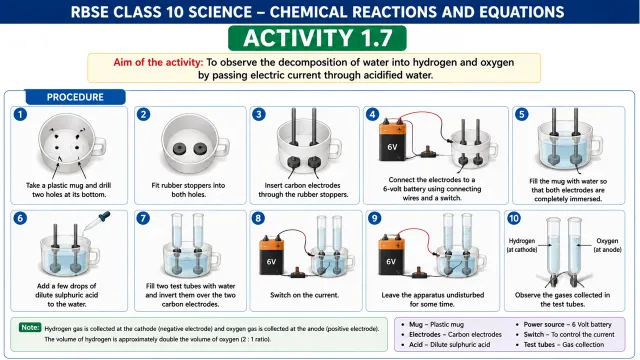
- Take a plastic mug and drill two holes at its bottom.
- Fit rubber stoppers into both holes.
- Insert carbon electrodes through the rubber stoppers.
- Connect the electrodes to a 6 volt battery using connecting wires and a switch.
- Fill the mug with water so that both electrodes are completely immersed.
- Add a few drops of dilute sulphuric acid to the water.
- Fill two test tubes with water and invert them over the carbon electrodes.
- Switch on the current and leave the apparatus undisturbed for a few minutes.
- Observe the gases collected in the test tubes.
Observation
- Bubbles of gas are produced at both carbon electrodes.
- Gas collects in both inverted tubes.
- The volume of gas collected at the cathode is approximately double the volume collected at the anode.
- Hydrogen gas is collected at the cathode while oxygen gas is collected at the anode.
- The ratio of hydrogen to oxygen is 2:1.
Chemical Reaction
2H2O→ 2H2 + O2
Explanation
Pure water is a poor conductor of electricity. Therefore a few drops of dilute sulphuric acid are added to increase its electrical conductivity.
The process of electrolysis decomposes water into hydrogen and oxygen
Following reaction takes place at electrodes
At cathode
Reduction reaction takes place at cathode
2H+ + 2e– →H2 gas
Hydrogen gas is produced at cathode.
At anode
2H2O →O2 gas + 4H+ +4e–
Oxygen gas is produced at anode.
Water contains two hydrogen atoms for each oxygen atom so the volume of hydrogen gas produced is double that of oxygen.
Type of Chemical Reaction
Electrolytic Decomposition Reaction
A reaction in which a compound decomposition into simpler substances by passing electric current through it is called an electrolytic decomposition.
Conclusion
This activity shows the electrolysis (decomposition) of water into hydrogen and oxygen. Hydrogen gas is collected at the cathode and oxygen gas is collected at the anode.
Hydrogen gas has double volume that of oxygen.
Precautions
- Use only a low voltage battery.
- Ensure that the carbon electrodes are properly connected.
- Add only a few drops of dilute sulphruic acid.
- Make sure the test tubes are completely filled with water before inverting them.
- Perform the activity under the supervision of a teacher.
- Do not touch the electrodes while the current is flowing.
Viv Questions and Answers
Q1. Why is dilute sulphuric acid added to water?
Answer – To increase the electrical conductivity of water.
Q2. Which gas is collected at the cathode?
Answer – Hydrogen gas
Q3. Which gas is collected at the anode?
Answer – Oxygen gas
Q4. What is the ration of hydrogen to oxygen produced during electrolysis?
Answer – 2:1
Q5. Which electrodes are used in this activity?
Answer – Carbon electrodes
Q6. What type of reaction is demonstrated in this activity?
Answer – Electrolytic decomposition reaction
Q7. What does this activity prove about water?
Answer- It proves that water is composed of hydrogen and oxygen.
Key Learning Points
- Water decomposes into hydrogen and oxygen on passing electric current.
- Dilute sulphuric acid increases the electrical
- Hydeogen is produced at cathode.
- Oxygen is produced at the anode.
- Hydrogen and oxygen are obtained in the ration of 2:1.
- The reaction is an electrolysis decomposition reaction.
Multiple Choice Questions
Q1. Which acid is added to water in this activity?
- Hydrochloric acid
- Nitic acid
- Sulphuric acid
- Acetic acid
Q2. Why is dilute sulphuric acid added to water?
- To produce hydrogen gas
- To increase the electrical conductivity of water
- To change the colour of water
- To cool the solution
Q3. Which gas is produced at the cathode?
- Oxygen
- Nitrogen
- Hydrogen
- Carbon dioxide
Q4. What is the ration of hydrogen to oxygen obtained during electrolysis?
- 1:1
- 1:2
- 2:1
- 3:1
Q5.which type of reaction is demonstrated in this activity?
- Combination reaction
- Displacement reaction
- Electrolytic decomposition
- Double displacement
Q6. Which electrodes are used in this activity?
- Iron electrodes
- Copper electrodes
- Zinc electrodes
- Carbon electrodes
Answers
Q1 (c)
Q2.(b)
Q3.(c)
Q4.(c)
Q5.(c)
Q6(d)