RBSE Class 10 Science Physics Chapter 11 Electricity MCQs (Objectives) are very important for students preparing for Board Exams. These MCQS have been prepared on the basis of important topics of Electricity.
In this post, you will find high- quality, exam oriented MCQs with answers prepared according to the latest RBSE Class 10 Science syllabus. You can solve these MCQs after reading Quick Revision Notes and also solve the questions of the chapter Electricity.
Whether you are a student looking for quick revision or a teacher searching for readymade study material, this post is for you.
Chapter 12 Electricity Class 10 Objectives with Answers
Choose the correct answer of the following questions:
1.If unit charge is taken to a point and potential difference is 1 volt, the work done is
(a) 4.2 joule
(b)1 joule
(c) 1 kWh
(d)1 kW
Correct answer- (b)
2.When a current of I ampere is passed, through a resistor of R ohm for t seconds, the amount of heat liberated is
(a)H=I2Rt cal
(b)H=I2Rt k.cal
(c)H=I2Rt Joule
(d)H=I2Rt/4.18 Joule
Correct answer-(c)
3.If Q charge flows in a circuit in t second, the current will be
(a) Q × t ampere
(b) ampere /t
(c) Q× t2 ampere
(d)ampere
Correct answer- (d)
4.To find the potential difference between two points, we use
(a) ammeter
(b)voltameter
(c) voltmeter
(d)galvanometer
Correct answer- (c)
5.To find the magnitude of current, we use
(a) ammeter
(b)voltameter
(c) voltmeter
(d)galvanometer
Correct answer- (a)
6.Three resistance of 1Ohm each are connected to form a triangle. The resistance between any two terminal is
(a)½ Ohm
(b)3 Ohm
(c)2/3 ohm
(d)3/2 Ohm
Correct answer –(c)
7.V α I, this relation was given by
(a) Faraday
(b) Watt
(c) Ohm
(d) Coulomb
Correct answer- (c)
8.The unit of potential difference is
(a) ampere
(b) volt
(c) ohm
(d) watt
Correct answer- (b)
9.The unit of resistance is
(a) ampere
(b)volt
(c) ohm
(d)watt
Correct answer- (c)
10.The unit of current is
(a) ampere
(b)volt
(c) ohm
(d)watt
Correct answer- (a)
11.No current flows between two charged bodies when they are connected, if they have same
(a)Potential
(b)Capacity
(c)Charge
(d)None of these
Correct answer- (a)
12.The unit of power is
(a) ampere
(b)volt
(c) ohm
(d)watt
Correct answer- (d)
13.In general , electric appliances are rated with –
(a)Current and voltage
(b)Power and voltage
(c)Voltage and charges
(d)None of these
Correct answer-(b)
14.Joule / coulomb represents
(a) ampere
(b) volt
(c) ohm
(d) watt
Correct answer- (a)
15.Volt / ampere represents
(a) ampere
(b)volt
(c) ohm
(d)watt
Correct answer- (c)
16.Volt × ampere represents
(a) ampere
(b)volt
(c) ohm
(d)watt
Correct answer- (d)
17.If resistance is R, current is I and time is t (in seconds) which formula is incorrect for the heat produced
(a) H = V.I.t
(b)H =
(c) H = IR2t
(d)H = I2Rt
Correct answer- (c)
18.If two resistances of 2 ohm each, are connected in parallel the equivalent, resistance is
(a) 1 ohm
(b)2 ohm
(c) 4 ohm
(d)8 ohm
Correct answer- (a)
19.A continuous conducting path between the terminals of source of electricity is called-
(a)An electric circuit
(b)Ammeter
(c)Galvanometer
(d)Voltmeter
Correct answer-(a)
20. A bulb is rated 60 Q at 240 V, the current that flows in the filament of bulb is of
(a) 0.25 A
(b)4 A
(c) 14000 A
(d)0.4 A
Correct answer- (a)
21.The resistance of a conductor is 55 ohm and potential across its ends is 220 V, the value of current flowing in the circuit is
(a) 5 A
(b)0.04 A
(c) 0.25 A
(d)none of above
Correct answer- (d)
22. 3.6 1010 J is equal to
(a)1 kwh
(b)1000 kWh
(c)10 kWh
(d)1000 kwh
Correct answer- (a)
23.Resistance of a conductor depends on
(a) its length
(b)area of cross-section
(c) material of the conductor
(d)all the above
Correct answer- (d)
24.Electric current represents
(a)Charge per unit area
(b)Charge per unit time
(c)Charge per unit volume
(d)None of these
Correct answer –(b)
25.The law , governing the force between electric charges is known as-
(a)Ohm’s law
(b)Ampere’s law
(c)Coulomb’s law
(d)Faraday’s law
Correct answer –(c)
26.If an appliance of 1 watt is used for 1 second, energy consumed is
(a) 1 erg
(b)1 Wh
(c) 1 kWh
(d)1 Joule
Correct answer- (d)
27.A wire of uniform thickness and of resistance R is cut into two equal parts, resistance of each part is
(a) 2 R
(b)R2
(c) R/2
(d)4 R
Correct answer- (c)
28.The value of resultant resistant arranged in either series or in parallel is 2, each resistance is of
(a) 2 ohm
(b)1 ohm
(c) 4 ohm
(d)none of above
Correct answer- (b)
29.Heating effect of current is used in
(a) electric meter
(b)bulb
(c) generator
(d)voltameter
Correct answer- (b)
30. 1 kWh is equal to
(a) 3.6 × 10⁶ J
(b)6.3 × 10⁶ J
(c) 3.6 × 10³ J
(d)3.6 × 10⁵ J
Correct answer- (a)
31.In nature, the electric charge of any system is always equal to
(a)Half integral multiple of the least amount of charge
(b)Square of the least amount of charge
(c)Zero
(d)Integral multiple of the least amount of charge
Correct answer-(d)
32. What determines the rate at which energy is delivered by a current –
(a)Electric energy
(b)Electric power
(c)Electric current
(d)Potential difference
Correct answer-(b)
33.Among the following ,electric power is not determined by-
(a)P=I2R
(b)P=V2/R
(c)P=V/R
(d)P=VI
Correct answer-(c)
34.The relationship between V and I is constant at constant
(a) Pressure
(b)energy
(c) temperature
(d)all the above
Correct answer- (c)
35.The conductivity of a superconductor is –
(a)Infinite
(b)Very small
(c)Zero
(d)Very high
Correct answer- (a)
36.A bulb of 60 watt is connected to a line of 240 V, the current flowing through the filament of bulb is
(a) 0.25 A
(b) 4.0 A
(c) (240 × 60)
(d) 240 + 60 A
Correct answer- (a)
37.The power rating of electrical appliances is given by-
(a)VI
(b)I2V
(c)I2/R
(d)V2R
Correct answer- (a)
38.Which is correct relation between R, L and
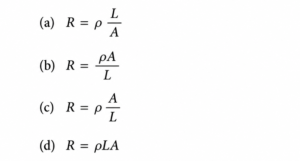
Correct answer- (c)
39.The instrument used to detect small current in the circuit is-
(a)Ammeter
(b)Galvanometer
(c)Voltmeter
(d)Rheostat
Correct answer- (b)
40.The maximum resistance which we can make using three resistors of 1/3 each, is
(a)1/3Ω
(b)1 Ω
(c) 1/9Ω
(d)3 Ω
Correct answer- (b)
41.The minimum resistance which we can make using three resistors of 1/3 Ω each, in
(a) 1/3Ω
(b)1 Ω
(c) 1/9Ω
(d)3 Ω
Correct answer- (c)
42.A student carries out an experiment and plots the V-I graph of three samples of nichrome wires with resistances, R1, R2 and R3. The true statement is
(a) R1 = R2 = R3
(b)R1 > R2 > R3
(c) R3 > R2 > R1
(d)R2 > R3 > R1
Correct answer- (b)
43.Unit of electrical power may also be expressed as
(a) Volt ampere
(b)Walt second
(c) Joule second
(d) kWh
Correct answer- (a)
44.The commercial unit of electric power is
(a)Watt
(b)Volt
(c)Kwh
(d)Ampere
Correct answer – (c)
45.When the length and area of cross section both are doubled then the resistance
(a)Will be doubled
(b)Will become half
(c)Will become four times
(d)Will be same
Correct answer- (d)
46.The electrical resistance of metals-
(a)Decreases with an increase in temperature
(b)No effect of temperature
(c)Increases with an increase in temperature
(d)Sometime increase and sometimes decrease with temperature
Correct answer-(c)
47.The conventional direction of electrical current is-
(a)Direction of flow of ions
(b)Direction of flow of electrons
(c)Direction of flow of positive charge
(d)None of these
Correct answer-(c)
48.In an electric circuit three incandescent bulbs A,B and C of rating 40W,60Wand 100W respectively are connected in parallel to an electric source. Which one of the following is likely to happen regarding their brightness?
(a)Brightness of bulb B will be more than that of A
(b)Brightness of bulb C will be less than that of B
(c)Brightness of all the bulbs is same.
(d)Brightness of bulb A will be maximum
Correct answer- (a)
49.The resistivity does not change if
(a)The temperature is changed
(b)The material is changed
(c)The shape of the resistor is changed
(d)Both material and temperature are changed
Correct answer- (c)
Related Topics