RBSE Class 10 Science Important Questions 2027 are useful for students preparing for RBSE Class 10 Board Examination 2027. A good practice paper helps students understand important concepts, improve numerical solving skills, prepare diagrams and become familiar with the examination pattern.
This article provides a complete 80 marks RBSE Class 10 Science Practice paper for the 2026-27 academic session; it includes questions from all 13 chapters and follows the RBSE syllabus.
This question paper includes multiple choice questions, fill in the blanks, very short, short answers type, numerical problems and diagrams based questions and long answer questions.
Download RBSE Class 10 Science Model Paper PDF
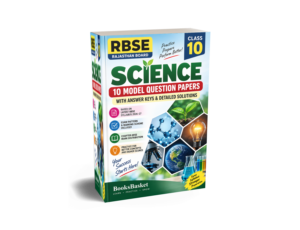
Students who want additional practice can download the complete RBSE Class 10 Science Model Question Paper PDF in English Medium
[Download RBSE Class 10 Science 10 sets Model Paper – Booksbasket]
The downloadable PDF provides additional practice material to help students prepare for the 2027 board examination.
RBSE Class 10 Science Exam Pattern 2027
The RBSE Class 10 Science theory examination carries 80 marks. The remaining 20 marks are allocated to sessional assessment.
| Particulars | Details |
| Board | Board of Secondary Education Rajasthan |
| Class | 10 |
| Subject | Science |
| Academic session | 2026-27 |
| Theory marks | 80 |
| Sessional assessment | 20 |
| Total marks | 100 |
| Exam duration | 3 Hours 15 Minutes |
| Text book | NCERT Science |
RBSE Class 10 Science Important Questions 2027
Time – 3 Hours 15 Minutes Maximum Marks-80
General Instructions:
- All questions are compulsory.
- The question paper is divided into four sections A,B,C and D.
Section – A
Q1.Multiple choice Questions 18 ×1 =18
Write the correct option of answer of the following questions in the answer book.
(i).The reaction between zinc and copper sulphate solutions is an example of:
- Combination reaction
- Decomposition reaction
- Displacement reaction
- Double displacement reaction
(ii)A green coating formed on a copper vessel exposed to moist air is mainly:
- Copper oxide
- Copper sulphate
- Basic copper carbonate
- Copper chloride
(iii)Which of the following has the lowest pH value?
- Pure water
- Sodium hydroxide solution
- Lemon juice
- Soap solution
(iv)Which of the following is an amphoteric oxide?
- CO2
- ZnO
- SO2
- MgO
(v)The functional group present in ethanol is:
- -COOH
- -CHO
- -OH
- -CO-
(vi)Soap molecules form………………..in water to remove oily dirt.
- Alloys
- micelles
- Crystals
- Salts
(vii)The site of gaseous exchange in human lungs is:
- Trachea
- Bronchi
- Alveoli
- Larynx
(viii)The junction between two neurons is called:
- Axon
- Synapse
- Dendrite
- receptor
(ix)Which plant hormone promotes cell elongation?
- Auxin
- Insulin
- Adrenaline
- thyroxine
(x)The eyes of a potato are associated with:
- pollination
- vegetative propagation
- fertilisation
- seed formation
(xi)Gregor Mendel conducted his experiments on:
- Rose plants
- Pea plants
- Wheat plants
- Mango plants
(xii)Myopia is corrected using:
- Convex lens
- Concave lens
- Plane glass
- Bifocal lens
(xiii)The splitting of white light into its constituents colours is called:
- Reflection
- Refraction
- Dispersion
- scattering
(xiv)The SI unit of electrical resistance is:
- Ampere
- Volt
- Ohm
- watt
(xv)If two resistors are connected in series, their equivalent resistance is:
- Less than the smallest resistance
- Equal to their sum
- Equal to their product
- Always zero
(xvi)The magnetic field inside a current carrying solenoid is:
- Zero
- Nearly uniform
- Always circular
- random
(xvii)Which rule is used to determine the direction of the magnetic field around a straight current carrying conductor?
- Fleming’s left-hand rule
- Fleming’s right-hand rule
- Right hand thumb rule
- Ohm’s law
(xviii)Which of the following substances is mainly responsible for ozone layer depletion?
- Oxygen
- Nitrogen
- Chloro fluoro carbons
- Hydrogen
Q2. Fill in the blanks 6 ×1=6
- The process of slow destruction of metals due to the action of air and moisture is called………………………..
- Sodium hydroxide is prepared by the ………………. process using an aqueous solution of sodium chloride.
- The tissue that transports water and minerals in plants is called……………….
- The gap between two adjacent neurons is called a ……….
- The transfer of pollen grains from anther to stigma is known as……………………………………
- The SI unit of power of lens is……………..
Q3. Vey short Answer Questions 12 ×1=12
- What is a balanced chemical equation?
- Name the acid present in vinegar.
- What is an alloy?
- What is the function of stomata in plants?
- Name the hormone secreted by the pancreas that regulates blood sugar.
- What is a reflex action?
- What is fertilisation?
- What are inherited traits?
- Write the relation between the radius of curvature and focal length of a spherical mirror.
- Which lens is used to correct hypermetropia?
- State Ohm’s law.
- What is meant by a trophic level?
Section -B
Questions 4 to 13 carry 2 marks each
Q4. What happens when magnesium ribbon is burnt in air? Write the balanced chemical equation and mention the type of reaction.
Q5. Why is it necessary to neutralise acidic soil? Name one substance that farmers can add to acidic soil.
Q6. Write any two differences between metals and non-metals on the basis of their physical properties.
Q7. What is a homologous series? Write any two characteristics of its members.
Q8. Explain the role of saliva in the digestion of food. Name the enzyme present in saliva.
Q9. What is a reflex arc? Draw a simple labelled diagram showing its pathway.
Q10. Differentiate between sexual and asexual reproduction on any two points.
Q11. Differentiate between inherited traits and acquired traits with one example of each.
Q12. Why does the sky appear blue during the day? Explain with reference to the scattering of light.
Q13. Two resistors of 6Ω and 3Ω are connected in parallel. Calculate their equivalent resistance.
Section -C
Questions 14 to 17 carry 3 marks each. Internal choices are provided.
Q14. An object is placed at a distance of 30 cm in front of a convex lens of focal length 20 cm.
- Calculate the image distance using the lens formula.
- Calculate the magnification.
- State the nature of the image formed.
Or
Draw ray diagrams to show image formation by a concave mirror when an object is placed:
- Beyond the centre of curvature.
- At the centre of curvature.
Also write the position and nature of the image in both cases.
Q15. Explain the process of transport of water and minerals in plants. Describe the role of xylem and transpiration.
Or
Explain the process of double circulation in human beings. Why is it important.
Q16. State Joule’s law of heating. Write its mathematical expression and explain any two applications of the heating effect of electric current.
Or
Explain the magnetic field produced by a current carrying circular loop. State two factors that affect the strength of the magnetic field at its centre.
Q17. What is a solenoid? Draw its magnetic field pattern and explain how its behaves like a bar magnet when electric current passes through it.
Or
Explain myopia and hypermetropia. State the type of lens used to correct each defect of vision.
Section -D
Questions 18 to 20 carry 4 marks each. Internal choices are provided.
Q18. Draw a neat and labelled diagram of the human digestive system. Explain the functions of the following organs:
- Mouth
- Stomach
- Small intestine
- Liver
Or
Draw a neat and labelled diagram of the human excretory system. Explain the process of urine formation in the kidneys.
Q19. Draw a labelled diagram of a flower and explain sexual reproduction in flowering plants. Include the roles of the following:
- Stamen
- Pistil
- Pollination
- Fertilisation
Or
Explain Mendel’s monohybrid cross experiment with a suitable example. Show the F1 and F2 generations and write the phenotype ratio obtained in the F2 generation.
Q20. Write the chemical formula and one important use of each of the following compounds:
- Sodium hydroxide
- Bleaching powder
- Baking soda
- Washing soda
Or
What is an ecosystem? Explain the following with suitable examples:
- Producers
- Consumers
- Decomposers
- Food chain and the transfer of energy between trophic levels.
RBSE Class 10 Science Chapter – Wise Marks Distribution 2026-27
Students should prepare all 13 chapters according to the prescribed syllabus. The chapter-wise marks distribution can help them plan their revision.
| Chapter | Chapter name | Marks |
| 1 | Chemical Reactions and Equations | 6 |
| 2 | Acids, Bases and Salts | 7 |
| 3 | Metal and Non-Metals | 5 |
| 4 | Carbon and its Compounds | 7 |
| 5 | Life Processes | 8 |
| 6 | Control and Coordination | 6 |
| 7 | How Do Organisms Reproduce? | 7 |
| 8 | Heredity | 4 |
| 9 | Light- Reflection and Refraction | 8 |
| 10 | The Human eye and The Colourful World | 4 |
| 11 | Electricity | 7 |
| 12 | Magnetic Effects of Electric Current | 6 |
| 13 | Our Environment | 5 |
| Total | 80 |
RBSE Class 10 Science Chapters Carrying Highest Marks
According to the current chapter-wise marks distribution, the following chapters carry the highest marks:
| Chapter | Marks |
| Life Processes | 8 |
| Light- Reflection and Refraction | 8 |
| Acids, Bases and Salts | 7 |
| Carbon and its Compounds | 7 |
| How Do Organisms Reproduce? | 7 |
| Electricity | 7 |
Students should give proper attention to these chapters while preparing for the examination. However, chapters carrying fewer marks should not be ignored but these chapters are most important.
Important Topics to Revise Before the RBSE Class 10 Science Examination
Students should solve and practice this paper but must revise the following important topics form the text book.
Chemistry
- Types of chemical reactions and balancing chemical equations.
- Oxidation, reduction, corrosion and rancidity
- Acids, bases, salts and the pH scale.
- Importance of pH in everyday life.
- Chemical properties of metals and non-metals
- Reactivity series and ionic compounds.
- Properties of carbon and covalent bonding
- Homologous series and functional groups
- Ethanol, ethanoic acid, soaps and detergents
Biology
- Nutrition, respiration and transportation
- Human digestive and respiratory systems
- Transportation in plants
- Human excretory system and nephron
- Human brain, reflex action and plant hormones
- Asexual and sexual reproduction
- Reproduction in flowering plants
- Human reproductive system
- Mendel’s experiments and heredity
Physics
- Laws of reflection and refraction
- Ray diagrams for concave and convex mirrors
- Ray diagrams for convex and concave lenses
- Mirror formula and lens formula
- Defects of vision and their correction
- Ohm’s law and numerical problems
- Series and parallel combinations of resisitors
- Heating effect of electric current
- Magnetic field lines and solenoid
- Domestic electric circuits and safety devices
Our Environment
- Ecosystem and its components
- Food chain and food webs
- Trophic levels and the 10% law
- Biodegradable and non-biodegradable substances
- Ozon layer and depletion
- Waste management
How to Prepare the RBSE Class 10 Science Board Examination 2027
1.Complete all prescribed chapters
Read the NCERT Science text book carefully and make sure that you understand the concepts from all 13 chapters.
2.Practice chemical equations
Learn to write and balance chemical equations. Revise combination, decomposition, displacement and double displacement reactions.
3.Solve numerical problems
Give special attention to electricity, mirrors and lenses. Practise numerical questions using the correct formulae and sign convention.
4.Prepare important diagrams
Practise diagrams of the human digestive system, respiratory system, excretory system, flower, neuron and ray diagrams of mirrors and lenses.
5.Revise definitions and differences
Prepare short definitions, scientific terms and difference between important concepts. These are useful for objective and short answer questions.
6.Solve full length practice papers
Attempt complete 80 marks papers within the prescribed examinations time. This will help you improve speed, accuracy and time management.
7.Check your mistakes
After completing a practice paper, check you answers and identify the chapters that require further revision.
Frequently Asked Questions
1.How many sections are there in the RBSE Class 10 Science question paper?
The practice paper follows four sections: A,B,C and D.
2.How many marks does the RBSE Class 10 Science theory paper carry?
The theory examination carries 80 marks. The remaining 20 marks are allocated to sessional assessment.
3.How many chapters are included in the RBSE Class 10 Science syllabus 2026-27?
There are 13 chapters in the prescribed science syllabus.
4.Are these questions guaranteed to appear in the RBSE 2027 board examination?
No, these are selected practice questions based on the syllabus and previous year question paper style. The actual board examination may contain different questions.
5.Where can students download additional RBSE Class 10 Science model question papers?
Students can use Booksbasket.in to download through link provided below in this article.
Final words
Regular practice and complete syllabus preparation are important for scoring well in the RBSE Class 10 Science examination. Students should understand the concepts, practise numerical problems, revise chemical reactions and prepare important diagrams.
Students must attempt these 80 marks practice paper under examination condition. After completing it, check your performance and revise the topics in which you need improvement.
Download the complete RBSE Class 10 Science set of 10 Model Paper form the Booksbasket link below