In RBSE Class 10 Science Chapter 1 Chemical Reactions and Equations, this group activity helps students understand two types of reactions through simple experiments. This activity also develops practical skills as observation, accurate temperature measurement.
Objective
To find which reactions are exothermic and which are endothermic.
Material Required
- Four beakers
- Water
- Copper sulphate [CuSO4]
- Potassium sulphate [K2SO4]
- Ammonium nitrate [NH4NO3]
- Iron filings
- Thermometer
Procedure
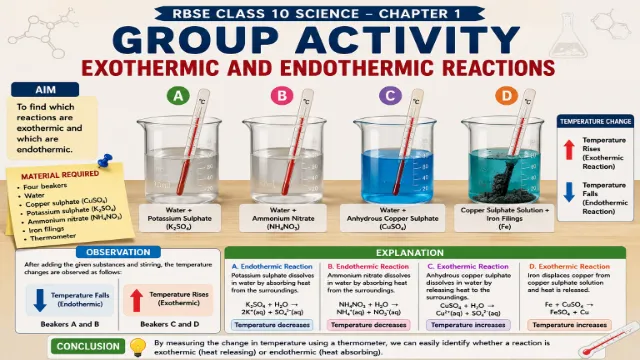
We will take four beakers and label them as A, B, C and D.
Now we pour 25 mL water in beakers A, B, C and copper sulphate in beaker D. After that we measure the temperature of each liquid taken in the beakers.
Now we add two spatulas of potassium sulphate, ammonium nitrate, anhydrous copper sulphate and iron filings into beakers respectively A,B,C and D and stir them.
After some time, we measure the temperature of each of mixture in the beakers.
Find out which reactions are exothermic and which ones are endothermic in nature.
Observation
We can note the temperature with help of thermometer, after performing the activity, we can observe the following
- The temperature rises in the beakers C and D and the temperature falls in the beakers A and B.
Explanation
- In the beaker A, the reaction takes place between potassium sulphate and water is an endothermic reaction.
When potassium sulphate is dissolved in water, it dissociates into potassium ion and sulphate ions and this dissolution of potassium sulphate absorbs energy from surroundings. so, it is an endothermic reaction.
K2SO4 + H2O → 2K+(aq) + SO42-(aq)
- In the beaker B, the reaction takes place between ammonium nitrate and water is an endothermic reaction.
When ammonium nitrate is dissolved in water, it dissociates into ammonium ion and nitrate ions and this dissolution of ammonium nitrate absorbs energy from surroundings.so it is an endothermic reaction.
NH4NO3 + H2O →NH4+ (aq) + NO3– (aq)
- In the beaker C , the reaction takes place between anhydrous copper sulphate and water is an exothermic reaction.
When anhydrous copper sulphate is dissolved in water, it dissociates into copper ion and sulphate ions and this dissolution of anhydrous copper sulphate release energy into the surroundings.so it is an exothermic reaction.
CuSO4 + H2O→ Cu2+(aq) + SO42-(aq)
- In the beaker D , the reaction takes place between copper sulphate solution and iron filings i is an exothermic reaction.
The reaction is displacement reaction and during the reaction, heat is released.
Fe + CuSO4 → FeSO4 + Cu
Conclusion
So, through this group activity of chapter chemical reactions and equations, we can easily conclude which reactions are exothermic and which are endothermic by measuring the temperature by thermometer.
Viva Question- Answers
Q1.Is potassium sulphate soluble in water?
Ans – Yes, potassium sulphate is soluble in water.
Q2.Does K2SO4 dissociates in water?
Ans – Yes. Potassium sulphate dissociates in water.
Q3.What is the formula of potassium sulphate?
Ans – K2SO4
Q4.What is exothermic reaction?
Ans – The chemical reaction in which heat is evolved when the reactants form products.
Q5.What is endothermic reaction?
Ans – The chemical reaction in which heat is absorbed from the surroundings.
Q6.What is displacement reaction?
Ans – The reactions in which less reactive element from a compound is displaced by a more reactive element, are called displacement reactions.
Q7.What is the formula of hydrated copper sulphate?
Ans – CuSO4.5H2O
Q8.Which among the following changes are exothermic or endothermic in nature?
- Decomposition of ferrous sulphate
- Dilution of sulphuric acid
- Dissolution of sodium hydroxide in water
- Dissolution of ammonium chloride in water
Ans – Dilution of sulphuric acid and dissociation of sodium hydroxide are exothermic reaction and decomposition of ferrous sulphate and dissolution of ammonium chloride are endothermic reaction.
Multiple choice question
Q1. What is the purpose of the group activity?
- To measure the temperature of beakers
- To identify the colour change in the beakers
- To identify the exothermic and endothermic reactions
- To observe the boiling points of the solutions
Correct answer – (c)
Q2. Which beaker shows the temperature decrease after the addition of substances?
- Beaker A
- Beaker B
- Both beaker A and B
- Neither beaker A nor B
Correct answer – (c )
Q3. What type of reaction takes place in the beaker B?
- Combination reaction
- Displacement reaction
- Exothermic reaction
- Endothermic reaction
Correct answer – (d)
Q4.Which equation represents the reaction in the beaker C?
- Fe+ CuSO4 FeSO4 + Cu
- CuSO4 +H2O Cu2+(aq) + SO42-(aq)
- NH4NO3 +H2O NH4+(aq) + NO3-+(aq)
- K2SO4 + H2O 2K+(aq) + SO42-(aq)
Correct answer –(b)
Q5. What happens when ammonium nitrate dissolves in water?
- It releases energy
- It absorbs energy
- It forms gas
- None of the above
Correct answer – (b)
Q6. Which beaker involves a displacement reaction ?
- Beaker A
- Beaker B
- Beaker C
- Beaker D
Correct answer – (d)